Attacker Infrastructure Behind Blockchain ClickFix

This is a div block with a Webflow interaction that will be triggered when the heading is in the view.

How do you find the attacker infrastructure behind blockchain-hosted ClickFix pages before it is used? Start from the technique, not from a list of domains. We seeded our scan with one behaviour: a page that reads its next step from a smart contract. Seven cycles of correlation later, that seed had led us to three separate operators. For each we found the wallets it signs with, the Cloudflare accounts it fills with domains it registered itself, and contracts it has deployed and not yet used. That is adversary infrastructure intelligence a defender can act on: staged infrastructure, found and tied to its operator before it is used. The same seed also caught several smaller kits. This post shows how each cycle fed the next and how defenders can act on the results in the controls they already run.
What we have confirmed so far is a sample, not a census. The scan is still running: nearly 2,000 live domains are confirmed, out of an estimated few thousand across Cloudflare. We share 500 of the operator-owned ones.
Key findings
- One seed, three operators. The seed is a technique: a page that reads its next step from a smart contract, then shows a fake check that asks the visitor to paste a command. By 18 November it had confirmed nearly 2,000 live domains (1,988), with the scan still running. The contracts those pages read split them into three main operations:
- ClearFake, on BNB Smart Chain testnet;
- Slaiclind, on Polygon;
- the "Beer" cluster of ErrTraffic, also on Polygon.
- Mostly operator-owned, not hacked. In the confirmed set so far, about two-thirds of the live domains (1,309) assess as registered and run by the operators themselves, inside their own Cloudflare accounts.
- ClearFake: 513 of 816 are operator-owned.
- Slaiclind: 705 of 751.
- ErrTraffic: about half compromised sites, as public reporting describes, plus a farm of its own.
- Identity from the chain. Contract ownership ties each fleet to a wallet. Slaiclind's two "different" wallets act within seconds of each other. Read back from the chain, their history gives every next-stage host the operator has used since 28 August: 36 hosts, 18 of them not in Stormshield's list, including the ones live today.
- Pre-attack indicators on chain. All three operators keep contracts that are deployed, and all but one maintained, yet loaded by no page. Slaiclind registers its next-stage hosts on the day it writes them into its contract. When we checked on 11 November, community feeds had caught the earlier hosts a median of one day after the write, and the newest were in no feed.
- What we share: a snapshot, not a census.
- 500 operator-owned domains, a sample of the nearly 2,000 confirmed so far.
- Those are themselves a sample: our random control points to an estimated few thousand of these loaders across Cloudflare.
- The scan continues, and we will update the snapshot as it does.
- The rest of the operator-owned domains, and the compromised and unclear ones, are available on request.
Pre-Attack Prevention, in one paragraph
Pre-Attack Prevention is the predictive threat intelligence and disruption layer of a preemptive cybersecurity program. It works in three steps:
- it observes adversary infrastructure while it is being staged (MITRE ATT&CK TA0042, Resource Development);
- it links that infrastructure into clusters run by the same operator, through Adversary Infrastructure Identity: the ownership, certificate, hosting and impersonation attributes that tie assets together;
- it delivers validated findings into the controls defenders already run, so their teams can act before the infrastructure is used.
The breadcrumbs an adversary leaves while building become Indicators of Pre-Attack (IoPAs), earlier-warning signals than IOCs because they describe adversary infrastructure while it is still being prepared. The period between building and use is the setup window. How far ahead of use we can act is the lead time.
This investigation is a worked example of all three steps. The interesting part is how much of the operators' infrastructure becomes visible once you stop starting from domains.
Why start from a technique: IOC feeds arrive too late
Domains are cheap, and these operators prove it. Slaiclind registers a new next-stage host, writes it into a contract, and drops it days later. A blocklist built from yesterday's domains is always behind.
A technique costs more to change. Every EtherHiding operator has to make its pages fetch their next step from a contract somewhere. Changing that means rebuilding the kit.
Others have done excellent work on each operation, and we build on it:
- ClearFake's use of BNB Smart Chain testnet contracts is documented in depth by Censys, Expel, Vega, Trend Micro, NOC.org, Cisco Talos and Ryan McEoin, among others. Its lure contracts circulate in public IOC feeds.
- Slaiclind was documented by Stormshield in October 2026. Its main contract already appears in at least one WordPress malware cleaner's signatures.
- ErrTraffic and its Polygon contracts were documented by Sekoia, WatchGuard, filescan.io and Source Defense.
A single search finds pages that call those hosts. A technique seed finds every operator that uses the technique, and each later signal sorts the matches and expands them. That difference is the subject of this post.
The seed
The seed is a behaviour, not an indicator. A page script:
- asks a public blockchain node for data stored in a smart contract;
- turns the answer into code, a list of hosts or a page address;
- loads the next stage;
- shows a fake security check that copies a command to the visitor's clipboard and asks them to paste it into Terminal, the Windows Run box or PowerShell.
The operator can change the lure, the payload or the next-stage host with one contract write, without touching a single site.
We describe the detection only by behaviour here. The point is that it does not depend on any domain, contract or wallet we already knew.
Cycle 1: from technique to pages
- The scan. Our web signature scan fetches pages and the scripts they load, as text, and matches them against the behaviour above. Nothing is executed.
- Repeat scans. Every match is rescanned from several regions over several days. A page that is clean from one place on one day is a miss, not a clean-up (the reason is in cycle 5).
- Packed scripts are unpacked, not guessed. Many injections hide the loader inside a packed script. We decode every saved packed script on each domain's latest page, statically, as text.
- The output was a set of live matching pages from several kits at once. After the 18 November daily run, 1,988 domains were active. That is a sample from a scan still in progress, not a total. The set moves daily: accounts switch the loader off and on, and new accounts join.
Cycle 2: from pages to contracts. One technique, three operators
Grouping by contract. For each match we extracted the contract the page reads, decoding packed scripts first, and grouped pages by contract. As of 18 November:
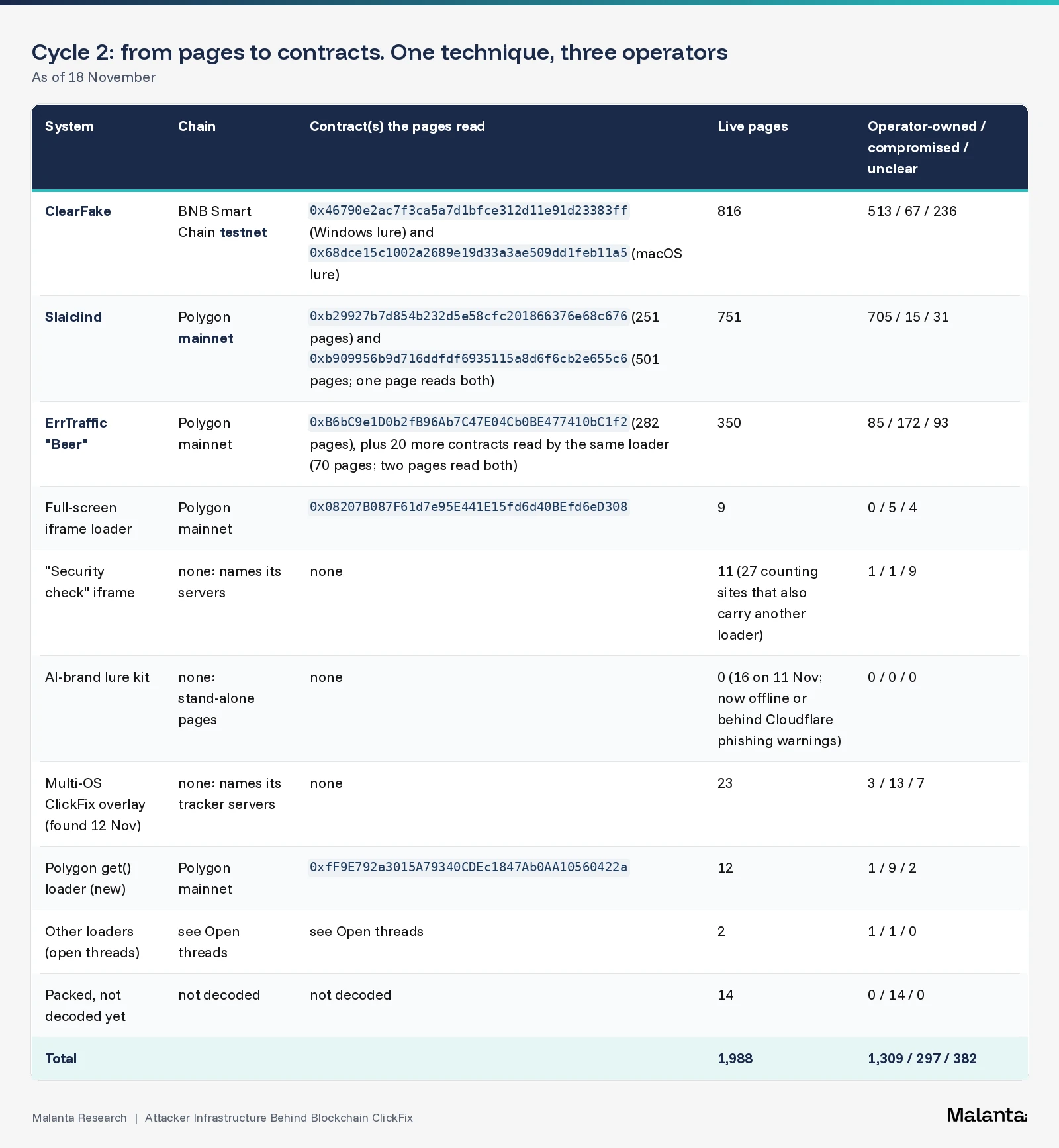
These are three operators, not three versions of one kit (assessed, High confidence). They use:
- two chains;
- three contract designs;
- free testnet tokens on one side and real money on the other;
- separate wallets and separate hosting accounts (cycles 3 and 5).
Who sits where differs by operator. ClearFake and Slaiclind live mostly on domains they registered. ErrTraffic, as public reporting describes, lives largely on compromised WordPress sites (172 of 350, with 93 more unclear), and also runs one farm of its own.
This is where a technique seed earns its keep. A domain seed would have found one of these operations; this one surfaced all three plus the smaller kits, and the contract signal told them apart.
Cycle 3: from contracts to wallets (Adversary Infrastructure Identity)
A contract is public, and so is its owner. Reading contract state is free and read-only. We used public RPC nodes, and archive nodes for past state.
ClearFake
- Same code, same owner, same tracker.
- The macOS and Windows lure contracts have identical bytecode.
- Both report the same owner:
0xd71f4cdc84420d2bd07f50787b4f998b4c2d5290. - Both report visitors to the same tracking contract:
0xf4a32588b50a59a82fbA148d436081A48d80832A.
- A busy wallet, with a tell-tale balance.
- The owner wallet has made about 760,000 testnet transactions.
- On BNB Smart Chain mainnet it holds exactly 0.002 BNB, the minimum the official testnet faucet requires before it hands out test tokens. The operator's only real-money footprint is the price of free gas.
- Following the wallet shows contracts no page uses yet:
0x0f14777c78d402bed55a67a6eb55dc87cc0b050a, a third macOS lure contract with newer bytecode;0x998d578f4224a9e7de83adeb74b8a547b34e20c0, a new lure template: a fake Turnstile check with a placeholder for the site's host name.
Slaiclind
Stormshield documented the main contract, 0xb299…c676, and a sibling it found unused, 0xb2a4ea7055b7e2a6b2d96502f0ff85024e72987b. Both are owned by 0xd7d0b350291ea7c16dc864563bc1bcaea0fb0949. The pages we matched add more:
- A second live contract under a different wallet. 501 pages read
0xb909…55c6. It has the same bytecode and stored the same host list until 12 November, yet its owner is a different wallet,0x36f570d15d4317df2aba6b563cbb55223fe07d53. We found no mention of this contract in public reporting or in public code. - Since 12 November the operator has updated only
0xb909…and the standby, from the two wallets 13 to 23 seconds apart each time. - The two wallets act as one (High confidence that one operator controls both).
- On 4 November, both switched their contracts off within 3 seconds of each other, and back on 16 minutes later within 2 seconds.
- The same evening, a host change landed in both 6 seconds apart.
- How they were set up. Each wallet's first funding came from a different very high-volume wallet, most likely exchange withdrawals (Low confidence).
0xd7d0…received 250 POL on 28 August at 19:48 UTC and deployed the main contract one minute later.0x36f5…received 61 POL on 29 October and, within six minutes, deployed0xb909…and a third contract,0x371ae6868d3359041f5a5ed20ac78f32d75ade13. That third contract is empty and waiting.
- Every host the operator has used, read back from the chain. Each host change is a transaction, so the two wallets' history (89 transactions) is the operator's own change log. It contains:
- 36 next-stage hosts since 28 August;
- all 18 that Stormshield published, which validates the method;
- 18 that are not in Stormshield's list, 16 of them written on or after 19 October, the day of its report. On 18 November, 0xb909…, which most pages read, names
tthcsslread21[.]ccandtlschssl22read[.]cc; 0xb299… still namesfcdnbovres[.]ccandfudcomcheck[.]art.
- The "unused" sibling is a hot standby.
0xb2a4…received 17 host writes, each mirroring a host of a live contract. The operator keeps it in sync, ready to swap in. - The kill switch is used. There were 13 off-and-on cycles, most of them in the first weeks.
ErrTraffic "Beer" cluster
- One loader, 21 contracts. The packed loader decodes statically, with no execution, to a read of a Polygon contract across eight public RPC endpoints. The loader then adds the operator's script from the server the contract names.
- Most sites (282) read
0xB6bC…c1f2, the contract public reporting ties to ErrTraffic's "Beer" cluster. Since 12 November it returnsbrowse-cloud[.]codes, registered that day (browse-nnccodes[.]beerbefore). - Its
admin()wallet,0xcaf2c54e400437da717cf215181b170f65187abf, has made 1,069 transactions. - The same wallet keeps three more contracts that no page reads:
0x1d7f…dc1c,0x4166…a161and0x8ff1…901f. It updates them minutes after the live one; on 12 November it switched all three tocoffe-time-img[.]beer.
- Most sites (282) read
- Twenty more contracts, one shared template. 70 sites read 20 other contracts (two of them also read
0xB6bC…). All 20 share one bytecode, different from0xB6bC…'s. They have eight admin wallets between them: one runs eight of the contracts, and ErrTraffic's own admin wallet runs four. That fits public reporting of ErrTraffic as a service sold to several customers, with the operator using its own product too. One operator splitting its wallets is also possible (Low confidence either way). - Repacked on other sites, identical at home. Elsewhere the loader is repacked with new keys and names: the 350 sites carry 138 different copies. On ErrTraffic's own farm, all 38 copies are byte-identical.
The full-screen iframe loader
- What it does. A smaller Polygon kit reads a page address from
0x0820…D308and covers the visitor's screen with a full-screen iframe of it. The iframe is allowed to write to the clipboard, which is how a fake check plants the command it asks you to paste. - Who it skips. It runs on desktops only, skipping phones and tablets, and stays away for 30 to 90 days once a visitor has seen it.
- The contract. It has its own admin wallet; today it points to
sky.dolcefantasia[.]us.
The common pattern: infrastructure staged before use
All three operators keep deployed contracts that no live page reads, and write to all of them except Slaiclind's empty spare:
- ClearFake:
0x0f14…and0x998d…; - Slaiclind:
0xb2a4…and0x371a…; - ErrTraffic:
0x1d7f…,0x4166…and0x8ff1….
These are textbook IoPAs (Indicators of Pre-Attack):
- infrastructure assembled during Resource Development;
- tied by ownership to a known operator;
- not yet in use.
The lead time on them is open-ended: as of 18 November, no page loads them. Any page or process that starts reading them can be flagged on its first visitor.
Cycle 4: from code to confirmation
An independent second signal. Inside each contract group, the injected loader is byte-identical across sites, or decodes to the same loader:
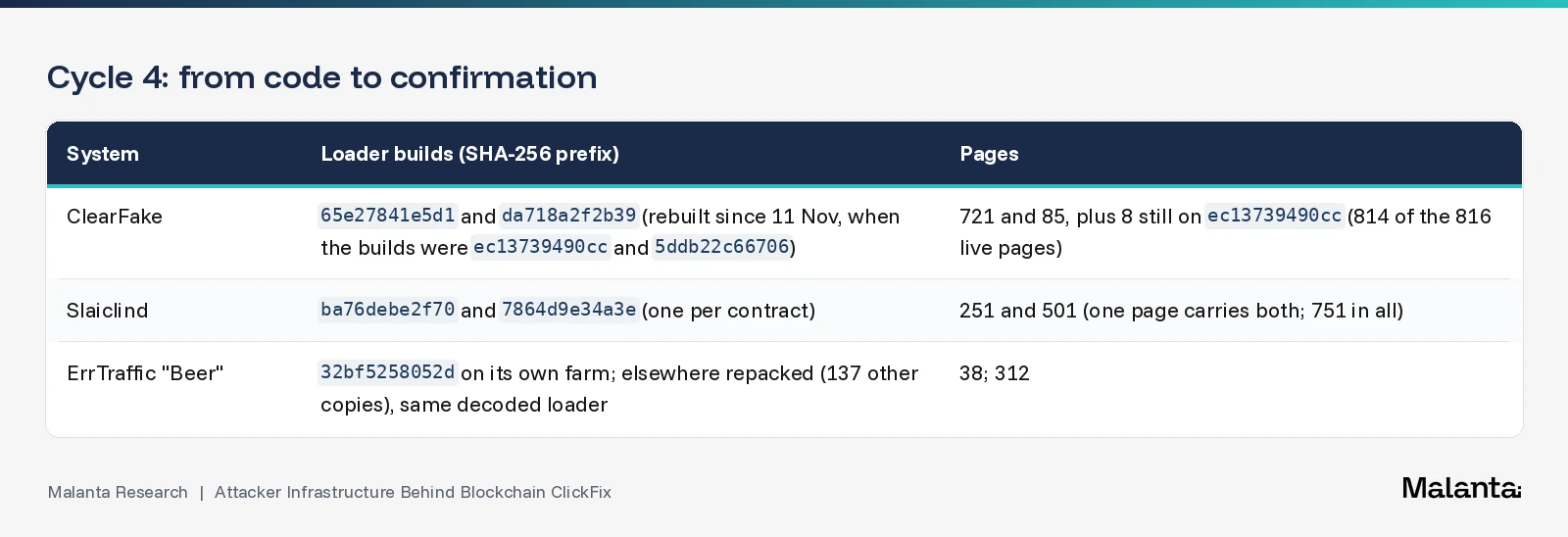
Why it matters. Identical code across hundreds of unrelated-looking sites agrees with the contract grouping without depending on it. When a new hash appears, it means a new build, and it becomes a new thread to pull.
A Slaiclind tell. On 11 November, 131 of its 175 pages at the time wrapped the injector in a div marked data-cfx, and in at least 121 of them the div was positioned off-screen. The marker is still common: on 18 November it shows on at least 291 of Slaiclind's 751 pages. That is a cheap hunting hint for site owners.
Cycle 5: from pages to hosting accounts
All three operators' own farms sit behind Cloudflare. Cloudflare assigns each account a nameserver pair, so a shared pair is a strong (not conclusive) hint of a shared account. We grouped matched zones by pair, then judged each account from three things: its domains' registration history, its co-tenants, and its content.
Each operator has its own accounts
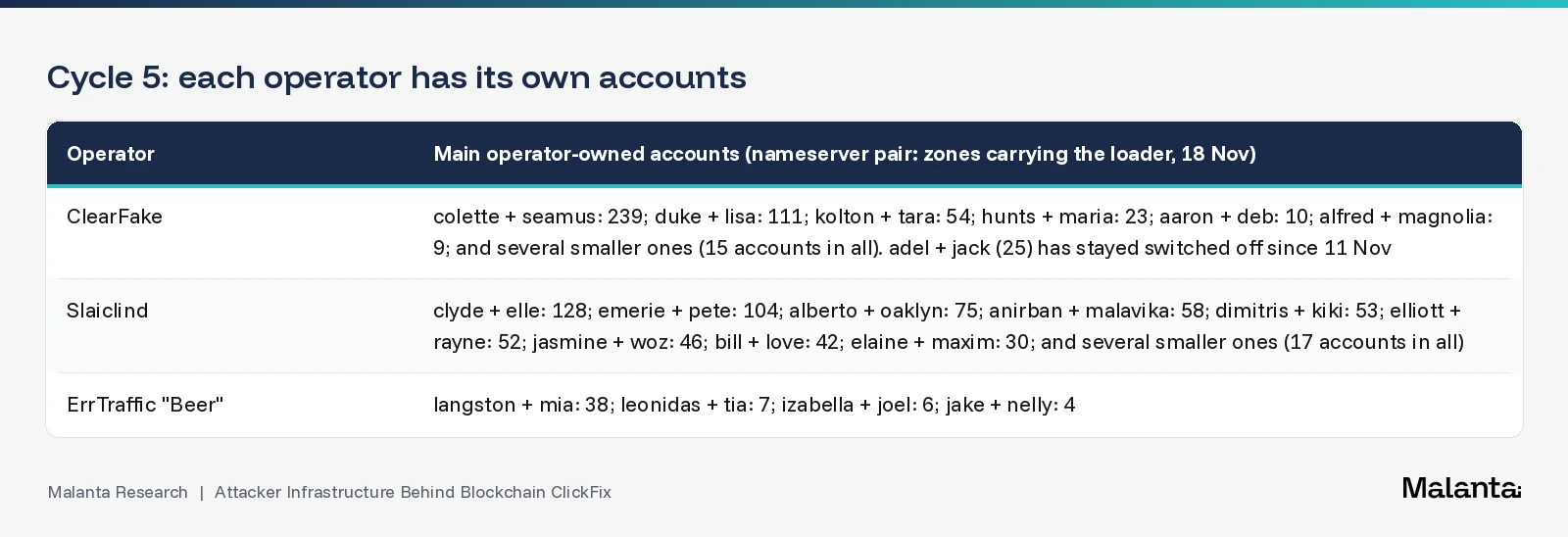
- With two exceptions so far, no operator account mixes the systems: on two Slaiclind accounts, one page each carries another loader (the "Security check" iframe on elliott + rayne, the new Polygon get() loader on bill + love). Only hijacked or mixed accounts, which belong to victims, carry more than one.
- The accounts are also the best pivot we have. Across every round so far, 4.7% of the other domains in accounts that already held two or more matches carried the loader (6.5% in the first round). In a random sample of Cloudflare-proxied domains, about 0.01% did. The account signal is roughly 500 times richer than chance.
- Each round found new operator accounts:
- account pivots found kolton + tara, ClearFake's newest account: 54 zones that look like music blogs, nothing like its earlier accounts, carrying the same loader;
- account pivots also found langston + mia, ErrTraffic's farm;
- taking a very wide account whole found clyde + elle, Slaiclind's first farm. Our usual width limit had skipped it;
- the Slaiclind farm's own site names led to jasmine + woz and bill + love;
- the 11 November run added elaine + maxim, a fourth Slaiclind account.
- rounds since 11 November added more Slaiclind accounts, the largest emerie + pete (104 zones), alberto + oaklyn (75), anirban + malavika (58) and dimitris + kiki (53), and seven smaller ClearFake ones.
Farms built from expired domains
- Slaiclind: 462 of 705, first created as far back as 1996
- ErrTraffic "Beer": 53 of 85 (the 38 on its farm were all registered on the same day, 27 January 2026)
- ClearFake: 43 of 513
- The point. An inherited creation date gets past "newly registered domain" rules and borrows whatever reputation the old owner built.
- The giveaway is in the registration history: a lapse, then a re-registration, often a registrar move, and a same-day cohort of dozens of others.
The edge, and accounts that switch off together (ClearFake)
ClearFake's accounts add two behaviours worth knowing:
- The loader is added at Cloudflare's edge, not on the site.
- It appears at the very end of pages that no CMS produced: Cloudflare's own "522: connection timed out" page (for example
123moviess[.]fooandfmovies[.]foo), redirects, and 404 pages for random paths. - Whoever controls the zone controls the injection.
- For site owners and hosters, this gives a one-request test: ask for a random path. If the 404 page carries the loader, the injection is at the zone, not in the CMS.
- It appears at the very end of pages that no CMS produced: Cloudflare's own "522: connection timed out" page (for example
- Whole accounts switch the loader off and on together.
- Our 9 November rescan found the loader gone from almost every zone in two accounts (239 zones down to 3, and 27 down to 0). The pages shrank by about the loader's size, with titles and content otherwise unchanged.
- On 10 November it was back. On 11 November the smaller account switched it off again.
- A one-off scan on the wrong day would have reported those accounts clean. That is why every match is rescanned from several regions before it is cleared.
Cycle 6: infrastructure tracking and the scan feed each other
The scan does not run on its own. Malanta already tracks attacker infrastructure as it is being assembled: reputation verdicts, and the clusters behind them that tie domains together by ownership and registrant identity, by shared certificates, and by IP infrastructure. The scan and that tracking feed each other.
From tracking to scan. Known attacker infrastructure is a seed tier of its own.
- Malicious domains. Domains Malanta already classifies as malicious, and that sit behind Cloudflare, matched at about 0.5%, roughly fifty times the random rate.
- What that tier found:
- ClearFake domains on accounts our account pivots had not reached yet;
- packed injections on compromised sites, which no account pivot could reach.
- Cluster neighbours. Domains in the same ownership, certificate and IP-infrastructure clusters as known matches are scanned the same way.
From scan to tracking. What the scan confirms flows back:
- each matched domain becomes an indicator;
- each operator account, owner wallet and staged contract becomes an identity that links new domains to their operator as soon as they appear.
The next round of clustering starts from a larger, operator-labelled set, and the next scan starts from richer seeds.
Why the loop matters. Neither side alone sees the whole operation.
- Page signatures see what a site serves today.
- Infrastructure tracking sees who registered it, who certified and hosted it, and what else they own.
Joined, they turn one matching page into the operator's fleet, and the fleet into the seed for the next cycle.
Cycle 7: from lure to payload
We followed one click on a ClearFake macOS lure, read-only:
- The copied command fetches a stage-1 AppleScript.
- The AppleScript installs a LaunchAgent named like
com.Apple.<16 lowercase letters>.plist. - That runs the Phexia loader (WithSecure, 4 November 2026).
- Phexia's November build gets its list of Polygon RPC nodes from
chainlist[.]org/rpcs.json, with no built-in fallback. - It reads its C2 from Polygon contract
0x3445fB8Df432320251f611e691fe6B0C6664C960. On 9 November that returnedogxlhwb[.]xyz.
To our knowledge, the link from ClearFake's BNB-testnet lure to Phexia has not been reported before.
The same scan also caught a separate kit: 16 stand-alone fake "Just a moment…" pages promising early access to AI tools (Claude, Gemini, DeepSeek), OpenAI credit, or crypto staking and airdrops. By 18 November, all of them were offline or behind Cloudflare phishing warnings.
- They were registered at NICENIC in September and October 2026, behind Cloudflare.
- They serve one macOS command, which pulls a MacSync-style payload from
geniecomputex[.]com, and a PowerShell command for Windows fromthreejrev[.]com. - Their shared payload address is the seed for the next round.
The "Security check" iframe kit needs no blockchain. It dims the page and opens a full-screen "Security check" iframe from servers it names directly, each a domain with an IP address as fallback. It sits on 27 sites, 13 of which also carry the ErrTraffic loader. So the two reach the same sites: one operator, or the same access sold or shared.
We did not follow Slaiclind or ErrTraffic past their contracts: both chains are Windows-focused and already documented.
How much is left
A seed that pivots well can still miss what is not connected to anything already known. So every scan carries a random control.
- The universe. Of 285 million live domains, 37.9 million answer from Cloudflare's address ranges.
- What the control shows. It keeps finding these loaders on accounts with no known match, which only a sweep can reach. Our estimate is a few thousand across Cloudflare in total.
The 1,988 live domains are a sample. The 500 we publish are a sample of that sample. The scan continues.
A few examples, up close
1. An operator's change log, read from the chain. Stormshield listed 18 Slaiclind hosts in October. The two wallets' history gives 36 by 18 November, in order, with timestamps. It shows each host's first day, when the kill switch was thrown, and when the standby contract was updated. Nothing had to be run or detonated: the operator's own transactions are the record.
2. Throwaway hosts, durable contracts. Of the 12 hosts not in Stormshield's list by 11 November:
- 11 were registered on the day they were written to the contract, and one the day before;
- they are mostly from one registrar, each on a different Cloudflare nameserver pair;
- seven of the ten older ones were on registrar hold by that day.
Every takedown was absorbed within hours by one contract write. Taking down hosts is necessary, yet never sufficient; the contract and the wallet are the durable layer.
3. The contract is the earliest public signal. We last checked the feeds on 11 November. Of the 30 hosts written by then:
- 22 reached public community feeds, a median of one day (0 to 10 days) after the contract write;
- the newest, including the pair live that day, were in none of them.
The six hosts written since 12 November have not been checked against the feeds yet. Watching the wallet gives defenders each new host when it is written. That is a lead over the feeds, and on 11 November it was the only signal at all for the newest hosts.
4. A loader on Cloudflare's own error page. When the origin behind 123moviess[.]foo timed out, Cloudflare served its standard 522 page, and the ClearFake loader was appended to it. It was still there on 18 November. No website produces that page, which places the injection at the zone.
5. A ledger on a public chain. ClearFake's tracking contract stores an eight-character visitor ID and an IPv4 address for each visitor it tracks. In two one-hour samples on 9 and 10 November, about 30 tracked visitors an hour were added (Medium confidence). The writes emit no events, so log-based counters read zero; we counted transactions instead. Those IP addresses are now permanently public. We do not publish any.
6. One file between Phexia and its C2. Phexia's November build cannot find its C2 if chainlist[.]org/rpcs.json is unreachable or changed. That is a single point of failure that defenders, and the service's maintainers, can use.
7. Why your browser shows nothing. Analysts who open a reported page often see a normal site. That is by design:
- the server decides per visitor whether to serve the lure;
- both iframe kits remember a visitor who has seen it, for 30 to 90 days or in local storage;
- one kit skips phones and tablets entirely.
A clean look from one browser proves little; the code on the page is the evidence.
8. Infections pile up. On compromised sites, injections accumulate:
- 165 sites carry two or more separately packed copies, up to 24 on one page;
- 13 carry both the ErrTraffic loader and the "Security check" iframe.
Cleaning one copy leaves the rest. Site owners should look for every injected script, not only the first.
Open threads (the next cycles)
- 14 packed injections not decoded. On 12 of these sites the loader was gone when we fetched them again on 18 November. Of the other two, one uses a string-array obfuscator rather than the XOR packers; the other is the planted plugin below. The large scripts we could not read before were the multi-OS ClickFix overlay, packed with a custom alphabet and a xorshift key stream.
- A new Polygon loader. Twelve sites, nine of them compromised, carry a loader that calls
get()on0xfF9E…422aand decrypts the answer with its own key schedule. We have not followed it further yet. - An older ClearFake still live. One compromised site still carries a contract from ClearFake's earlier, 2025 generation on BNB Smart Chain mainnet (publicly reported in March 2025).
- A planted WordPress plugin. Two compromised sites carry a planted plugin whose settings name another contract, one already listed in public web3-injection detectors and blocklists.
- An unexplained Polygon contract. Two compromised sites carry one that nothing public mentions.
- Watching the wallets. We read them for new contracts and new hosts, and will publish what changes.
Acting before use: actions in existing controls
Pre-Attack Prevention is only useful if it ends in an action a defender can take in the tools their team already runs.
- SOC / network. Load the 500-domain snapshot into DNS or web-proxy blocking, and refresh it as we publish updates. Why it works before use: Operator-owned zones come back after "going clean" (cycle 5). Blocking the whole account's zones covers dormant ones too.
- SOC / network. Alert on browser calls to BNB Smart Chain testnet RPC endpoints from ordinary page loads, and consider blocking them outright; review browser calls to Polygon RPCs from non-crypto sites. Why it works before use: Every blockchain-backed page in these kits has to make that call before anything else happens.
- SOC / triage. When checking a reported page, use a fresh desktop browser profile, and judge by the code on the page, not by what renders. Why it works before use: The kits skip phones, remember visitors for up to 90 days, and let the server choose who sees the lure.
- Threat intel. Watch the wallets and contracts listed below, and push each newly written host to blocking within the hour. Why it works before use: In our 11 November check, feeds lagged by about a day and the newest hosts were in none of them.
- Threat intel. Add the seven staged contracts to detection content now. Why it works before use: No page reads them yet: an alert fires on the first page that does.
- Endpoint. macOS: Terminal launching
bash, which then launchesosascript; newcom.Apple.<16 lowercase>.plistLaunchAgents;curlfrom shell processes to Polygon RPCs orchainlist[.]org. Windows: Run-box or PowerShell launches right after browsing. Why it works before use: Catches the paste, the last step the operator can't move on chain. - Cloudflare / hosting. For operator-owned accounts, act on the account, not the zone. For hijacked accounts: owner notification, MFA, API-token rotation, a review of Workers and Snippets. Why it works before use: Zone-by-zone takedown leaves the account's other zones live.
- RPC providers. Decline to serve these contracts. One provider already refuses the ClearFake contracts. Why it works before use: Pages cycle through a short list of public endpoints; every refusal shortens it.
- Registrars. Fast-track holds on next-stage hosts as they appear on chain. Why it works before use: Seven of the older hosts were on hold by 11 November; acting the same day removes the window entirely.
- Site owners. Request a random path on your site. If the 404 page carries an unknown script at the very end, check your Cloudflare account, not only your CMS. On WordPress, look for every injected script and for plugins you did not install. Why it works before use: Edge injection survives a CMS clean-up, and injections pile up.
Method and sharing
How we worked:
- Read-only throughout. Pages and scripts were fetched as text and never executed. Packed scripts were decoded statically, as text. Chain data came from view calls and historical state on public nodes. We wrote nothing to any chain, contacted no operator server, and pasted no commands.
- Owner assessment. Each domain was judged operator-owned, compromised or unclear from its registration history (age, re-registration, same-day cohorts), its Cloudflare account and co-tenants, and where the injection sits (edge, site files, or inline). Only high-confidence operator-owned domains are published.
- Victim data. Withheld. We publish no visitor IDs or IP addresses from the tracking contract, and no compromised site names.
What we publish: a 500-domain snapshot on GitHub. It is a sample of the confirmed set, which is itself a sample of what is out there. Each row gives the domain (defanged), the system, the contract(s), the loader hash, the Cloudflare nameserver pair, the registration date, and first and last seen. The result:
- ClearFake: 277
- Slaiclind: 179
- ErrTraffic "Beer": 44
- AI-brand kit: 0
The 500 sit on 30 Cloudflare accounts, and 160 of them are expired domains bought back.
On request: the other 809 operator-owned domains confirmed so far, the 297 compromised sites, the 382 unclear ones, and new matches as the scan finds them. Write to [email protected]. Compromised sites are victims: we share them with the parties who can help them, not in a public list.
How confident we are
- The 1,988 confirmed domains served one of these loaders when scanned. High (repeat scans; byte-identical or decoded code)
- The contract groups are three separate operators. High
- ClearFake's lure contracts and the staged contracts share one owner. High (on-chain
owner()and writes) - One operator controls both Slaiclind wallets. High (shared bytecode and state; writes seconds apart)
- The 20 extra
api.phpcontracts belong with ErrTraffic's "Beer" cluster. Medium (same loader; one shared bytecode; eight admin wallets, one of them the main contract's) - Those 20 are separate customers of one service, rather than one operator. Low
- The staged contracts are meant for future use. Medium (deployed, all but one maintained, but unused)
- About two-thirds of the confirmed live domains are operator-owned. High for the high-confidence set; the 382 unclear are excluded
- The wallets were funded from exchanges. Low
- About 30 tracked visitors an hour on ClearFake's ledger. Medium (two one-hour samples, 9 and 10 Nov)
- The 14 packed injections not decoded carry the same loaders. Medium (they sit next to decoded copies on other pages; 12 no longer carried a loader on 18 Nov)
- A few thousand of these loaders across Cloudflare in total; the confirmed set is a floor. Medium (random-sample control; wide range)
Frequently asked questions
How can defenders act on attacker infrastructure before IOC feeds catch up?
Watch the operator's wallets and contracts, not only its domains. In this investigation, when we checked on 11 November, community feeds had listed Slaiclind's earlier next-stage hosts a median of one day after the operator wrote them to its contract, and the newest hosts were in no feed at all. Watching the wallets gives each new host when it is written. The staged contracts can go into detection content now, and the 500-domain snapshot into DNS or web-proxy blocking.
What is a blockchain-hosted ClickFix page?
A ClickFix page shows a fake security check that copies a command to the visitor's clipboard and asks them to paste it into Terminal, the Windows Run box or PowerShell. In the blockchain-hosted variant, known as EtherHiding, the page first asks a public blockchain node for data stored in a smart contract and uses the answer to load its next stage. The operator can then change the lure, the payload or the next-stage host with one contract write, without touching a single site.
Why does a reported ClickFix page look clean when an analyst opens it?
By design. The server decides per visitor whether to serve the lure, both iframe kits remember a visitor who has seen it, and one kit skips phones and tablets entirely. Judge by the code on the page, from a fresh desktop browser profile, not by what renders.
Are these findings IoPAs or IOCs?
The staged contracts, deployed by known operators yet loaded by no page, are Indicators of Pre-Attack (IoPAs): adversary infrastructure assembled during MITRE ATT&CK TA0042 Resource Development and not yet in use. Lure contracts that already circulate in public feeds are IOCs.
The Bottom Line
Starting from a technique instead of a domain list turned one behaviour into three operators' wallets, hosting accounts and staged contracts, most of them on infrastructure the operators registered themselves. The durable layer is the contract and the wallet, not the throwaway host: watching the Slaiclind wallets gave each new host on the day it was written, while, in our 11 November check, community feeds had caught the earlier hosts a median of one day later and the newest not at all. For defenders, that is lead time they can spend in the blocking, detection and hosting controls they already run.
About Malanta. Malanta is a pre-attack / predictive threat intelligence platform for adversary infrastructure. Malanta delivers Pre-Attack Intelligence. It observes adversary infrastructure while it is being built, in MITRE ATT&CK TA0042 Resource Development, validates it into Indicators of Pre-Attack (IoPAs), and delivers them into the controls, workflows, and AI agents security teams already run. Founded in 2024, Malanta Ltd. is headquartered in Tel Aviv.
Indicators
All hosts and IP addresses are defanged. Contract and wallet addresses are given in full: they are public, and they are what defenders need to watch.
ClearFake (BNB Smart Chain testnet)
- Owner wallet:
0xd71f4cdc84420d2bd07f50787b4f998b4c2d5290 - Windows lure:
0x46790e2ac7f3ca5a7d1bfce312d11e91d23383ff - macOS lure:
0x68dce15c1002a2689e19d33a3ae509dd1feb11a5 - Visitor tracker:
0xf4a32588b50a59a82fbA148d436081A48d80832A - Router:
0xA1decFB75C8C0CA28C10517ce56B710baf727d2e - Staged, unused:
0x0f14777c78d402bed55a67a6eb55dc87cc0b050a,0x998d578f4224a9e7de83adeb74b8a547b34e20c0
ClearFake macOS payload (Phexia)
- Polygon contract
0x3445fB8Df432320251f611e691fe6B0C6664C960 - C2 on 9 Nov:
ogxlhwb[.]xyz - LaunchAgent name pattern
com.Apple.<16 lowercase>.plist
Slaiclind (Polygon)
- Wallets (one operator):
0xd7d0b350291ea7c16dc864563bc1bcaea0fb0949,0x36f570d15d4317df2aba6b563cbb55223fe07d53 - Live contracts:
0xb29927b7d854b232d5e58cfc201866376e68c676,0xb909956b9d716ddfdf6935115a8d6f6cb2e655c6 - Standby and spare:
0xb2a4ea7055b7e2a6b2d96502f0ff85024e72987b,0x371ae6868d3359041f5a5ed20ac78f32d75ade13
Next-stage hosts not in previous reporting, with the date each was first written:
check-cf[.]site(3 Sep)check-mdfcf[.]pw(20 Sep)checkgwfwtg465[.]art(19 Oct)check3wdsorobot[.]cc(19 Oct)btorsercoyt31[.]cc(20 Oct)zurggoyttjof21[.]cc(20 Oct)verifyidentrob01[.]cc(28 Oct)ubbrobccheck20[.]cc(28 Oct)checkogosdfg33[.]cc(3 Nov)govrobczxc[.]cc(3 Nov)fudcomcheck[.]art(4 Nov, live)fcdnbovres[.]cc(8 Nov, live)ocscdetec22[.]cc(12 Nov)webffoo001[.]cc(12 Nov)webffoo002[.]cc(12 Nov)webrtwtre22[.]cc(14 Nov)tthcsslread21[.]cc(17 Nov, live)tlschssl22read[.]cc(17 Nov, live)
ErrTraffic "Beer" cluster (Polygon)
- Contract
0xB6bC9e1D0b2fB96Ab7C47E04Cb0BE477410bC1f2; admin wallet0xcaf2c54e400437da717cf215181b170f65187abf; server named on 18 Nov:browse-cloud[.]codes; sites: 282 - Contract
0x83833C5D676cA06E941A32310AE67D0890F657eE; admin wallet0xf1940ddbda56074ce29bb0b6ea8d62db974870a5; server named on 18 Nov:makeverizyjar[.]info; sites: 15 - Contract
0xBAB25ceD421128C427ad19914473566633894dd5; admin wallet0x82e75ac51e05cd94313df80a7c47208afbcae8c5; server named on 18 Nov:lovezramexar[.]info; sites: 8 - Contract
0x0C7Cb01C83203aC0a50Abc3a9AFF3c9Ca727eF55; admin wallet0x2f9091ab4ec91c0daa67a7660c81a922328a8096; server named on 18 Nov:mon-blanc-02[.]cfd; sites: 11 - Contract
0xfD75a8F503be4851E11a52b645De1f017492A6b0; admin wallet0x2a51c1ed5c96882bee51f06ec08c1504b9921ec2; server named on 18 Nov:cloudeccentric[.]cc; sites: 9 - Contract
0x4dE37B7bE1bfb8a74acD8Af57a2c10c5B1A14BB3; admin wallet0x7ad158cd16eedb8825562f2eda68ad18bc4f2d76; server named on 18 Nov:cdn-speed[.]beer; sites: 10 - Contract
0x994Cb8274721E5d6dAA4fE3FeBf80CF9237A9ae8; admin wallet0xb0425bf235a2275735c8c5d668aa0273c65970b9; server named on 18 Nov:smtnscerver[.]beer; sites: 7 - Contract
0xDb93CE45DA3D013b2BE1525375d5f548Ca82b29a; admin wallet0xb0425bf235a2275735c8c5d668aa0273c65970b9; server named on 18 Nov:lskannsserv[.]beer; sites: 3 - Contract
0x1b6cFD93FfC6Ea17488A025980565F977f084DB7; admin wallet0xb0425bf235a2275735c8c5d668aa0273c65970b9; server named on 18 Nov:chekbrow[.]beer; sites: 2 - Contract
0x374854889E9A51D001dA4387667B8546F079bEFb; admin wallet0xcaf2c54e400437da717cf215181b170f65187abf; server named on 18 Nov:ghdnsserverns[.]beer; sites: 2 - Contract
0x8F2F173DF08A5531DD5b92753CfbaE422e04Ada0; admin wallet0x7ad158cd16eedb8825562f2eda68ad18bc4f2d76; server named on 18 Nov:cdn-speed[.]beer; sites: 2 - Contract
0x224579e572cEEc5309A7d9F5fAf85dea5dBb7D4A; admin wallet0xb0425bf235a2275735c8c5d668aa0273c65970b9; server named on 18 Nov:ntsnsdns[.]beer; sites: 1 - Contract
0xC0d1F4DF86E08dD4AD0cdd0085e7dc660aB21C63; admin wallet0x7ad158cd16eedb8825562f2eda68ad18bc4f2d76; server named on 18 Nov:cdn-speed[.]beer; sites: 1 - Contract
0x9130ec7e8B20646ad30E1386d1b45Cd26EB0e07b; admin wallet0xb0425bf235a2275735c8c5d668aa0273c65970b9; server named on 18 Nov:framesavecloudjs[.]beer; sites: 1 - Contract
0xb36482fE794B895695914779Db3909b471D1aA43; admin wallet0xcaf2c54e400437da717cf215181b170f65187abf; server named on 18 Nov:cloud-safe[.]click; sites: 1 - Contract
0xEB8A63ef6FCA91714715E09f69974a9F558EE3Cc; admin wallet0xb0425bf235a2275735c8c5d668aa0273c65970b9; server named on 18 Nov:ns-server-jscdn[.]beer; sites: 1 - Contract
0x576E26789220bb4dBBEc1f7bF6B794AbEda884Dc; admin wallet0xb0425bf235a2275735c8c5d668aa0273c65970b9; server named on 18 Nov:bootstrap-maxcdn[.]beer; sites: 1 - Contract
0x6C6Cadf48BdA2B3Dc60e96Cad36F23110190E477; admin wallet0xcaf2c54e400437da717cf215181b170f65187abf; server named on 18 Nov:cdn-server-styles[.]click; sites: 1 - Contract
0xc8375ed5D301691821e3211052Bf8236A6534802; admin wallet0xcaf2c54e400437da717cf215181b170f65187abf; server named on 18 Nov:web-security[.]beer; sites: 1 - Contract
0x5b0000aD5Cb9AaDEaF24EE9a7855cC7D5E063222; admin wallet0xb0425bf235a2275735c8c5d668aa0273c65970b9; server named on 18 Nov:dhnsdns[.]beer; sites: 1 - Contract
0x4694A69E6F34251d0E2E5e6B0A85AebA2cF6090F; admin wallet0x460597a2fd0cd963f3c0575ff44f1c14bc59839c; server named on 18 Nov:mikelle[.]beer; sites: 1 - Contract
0x1d7f164a74cec1042a9b3117794e6b93752adc1c; admin wallet0xcaf2c54e400437da717cf215181b170f65187abf; server named on 18 Nov:coffe-time-img[.]beer; sites: 0 (staged) - Contract
0x4166d8888380faea0932e0156c11e0e75856a161; admin wallet0xcaf2c54e400437da717cf215181b170f65187abf; server named on 18 Nov:coffe-time-img[.]beer; sites: 0 (staged) - Contract
0x8ff1ae790b65549ced90e0d7608fe2b68357901f; admin wallet0xcaf2c54e400437da717cf215181b170f65187abf; server named on 18 Nov:coffe-time-img[.]beer; sites: 0 (staged)
Sites are counted per contract, and a site can read more than one contract, so the sites add up to more than the cluster's 350: 280 read only 0xB6bC…, 68 read only template contracts, and 2 read both.
Full-screen iframe loader (Polygon)
- Contract
0x08207B087F61d7e95E441E15fd6d40BEfd6eD308 - Admin wallet
0x34c15320d6e8f59f1b66f6c191aaa7f87b894b66 - Page on 18 Nov:
sky.dolcefantasia[.]us - Cookies it sets:
_cf_verified,_wp_perf_ok
"Security check" iframe
cloudflare-check[.]net(fallback IP94.26.90[.]126)clickzona[.]net(fallback IP65.21.18[.]60)id-ll[.]com(fallback IP85.239.149[.]120)lmjcoulson[.]com(fallback IP85.239.144[.]131)
Multi-OS ClickFix overlay
- Tracker hosts (
/api?t=<token>&track=1):securityalertcaptchacheck[.]com,interseq[.]at,hagosuro[.]lc,cosmical2049[.]com,shatamilo[.]com,winehouser[.]com,gfisoda[.]biz,socialviewsec[.]lc,latoem[.]biz - Hosts in the commands it copies:
internetserchinkas[.]co,copiose[.]org,lepafonso[.]bz,hagosuro[.]lc,cosmical2049[.]com,gfisoda[.]biz
Polygon get() loader
- Contract
0xfF9E792a3015A79340CDEc1847Ab0AA10560422a, read withget()(0x6d4ce63c); the answer is encrypted
AI-brand lure kit
- Payload hosts
geniecomputex[.]com(macOS) andthreejrev[.]com(Windows) - The 16 lure domains were in the 11 November snapshot, not the 18 November one: none is live now
Loader builds (SHA-256 prefixes): 65e27841e5d1, da718a2f2b39 (ClearFake, current); ec13739490cc, 5ddb22c66706 (ClearFake, 11 Nov); ba76debe2f70, 7864d9e34a3e (Slaiclind); 32bf5258052d (ErrTraffic "Beer", its own farm).
RPC endpoints the loaders call (for egress hunting; these are legitimate services, so don't block them blindly):
- BNB Smart Chain testnet:
data-seed-prebsc-1-s1.bnbchain[.]orgdata-seed-prebsc-1-s1.binance[.]orgdata-seed-prebsc-2-s1.binance[.]orgdata-seed-prebsc-2-s2.binance[.]orgbsc-testnet-dataseed.bnbchain[.]orgbsc-testnet-rpc.publicnode[.]combsc-testnet.drpc[.]org
- Polygon:
polygon-rpc[.]com1rpc[.]iopolygon-bor-rpc.publicnode[.]compolygon.drpc[.]orgrpc.ankr[.]compolygon-public.nodies[.]apppolygon.gateway.tenderly[.]corpc-mainnet.matic.quiknode[.]propolygon-mainnet.public.blastapi[.]io
Domains: the 500-domain snapshot on GitHub.
References
- Censys, "EtherHiding: Fake CAPTCHAs, Click-Fix Lures, and Blockchain-Backed Payload Delivery" (21 Nov 2025)
- Expel, ClearFake research
- Vega, "Fake CAPTCHAs, Smart Contracts, Real Risk: Unpacking a ClickFix Campaign Delivering SectopRAT" (18 Feb 2026)
- Trend Micro, smart contracts for command and control (26 May 2026)
- NOC.org, ClickFix campaign and blockchain victim authorization (11 May 2026)
- Cisco Talos, ClearFake WebDAV infection chain (8 Sep 2026)
- Ryan McEoin, ClearFake analysis (9 Sep 2026)
- Netskope, blockchain DDR decoder and campaign snapshots (GitHub), including ClearFake's 2025 BNB mainnet contract
- Stormshield, "Slaiclind: analyzing a campaign combining ClickFix and EtherHiding" (19 Oct 2026)
- Sekoia, ErrTraffic research; WatchGuard Threat Lab, ErrTraffic (Aug 2026)
- filescan.io, "Tracing ClickFix Chain to a Live EtherHiding Resolution"; Source Defense research on
0xB6bC… - WithSecure, Phexia macOS malware (4 Nov 2026)
- Zscaler, "ClaudeFix: shared Claude chats meet ClickFix" (15 Jul 2026)