When AI Speeds Espionage, the Setup Window Is Still Visible

This is a div block with a Webflow interaction that will be triggered when the heading is in the view.

Most security teams still treat a major threat report as the starting gun.
A vendor or research lab publishes indicators. Feeds update. Playbooks fire. Analysts chase what everyone else is chasing. That reflex made sense when attacker infrastructure was scarce and human-paced. It makes less sense when the adversary uses AI to register domains, stage phishing kits, rebuild implants after detection, and keep the campaign moving without waiting for a human engineer to catch up.
Anthropic's September 2026 threat intelligence report put a hard example on the table: GTG-20006, a Russian espionage cluster Anthropic links to public reporting on Midnight Blizzard. The actor automated large parts of the operation with AI - from infrastructure acquisition and phishing to persistence and evasion loops that rebuild tooling when defenses flag it.
The story most people will take away is that AI raised attacker tempo.
That part is true. Yet it is incomplete.
Key findings
- Anthropic's 10 September 2026 report documents GTG-20006 as an AI-accelerated Russian espionage cluster whose early work still maps to MITRE ATT&CK TA0042 (Resource Development): acquire infrastructure, develop capabilities, stage delivery paths.
- Public disclosure is a disclosure event, not the first moment infrastructure existed. Domains, lookalike brands, and hosting were already in a setup window before the industry agreed the campaign was news.
- Against Anthropic's report date, nine of the reported seed domains were already classified malicious in Malanta's Pre-Attack Intelligence.
- Lead times ranged from +37 days to +175 days. Median across those nine malicious seeds: +39 days.
- Three Microsoft lookalikes (
ms365-live.com,ms365-device.com,owa-ms365.com) share a registrant identity cluster - Adversary Infrastructure Identity in practice, not volume-driven pivot theater. - Attribution labels can differ across vendors. Anthropic frames Midnight Blizzard-aligned espionage. The operational point does not: this was staged adversary infrastructure, already blockable before the report date.
- The board-level metric for this window is Mean Time to Preempt (MTTP): how quickly teams see and remove adversary infrastructure before it becomes a live delivery path.
What is inside
- What the report surfaces - and what it leaves open
- The question that should follow every AI-enabled case
- What Malanta saw ahead of the public disclosure
- Identity, not volume, is the durable signal
- Why this changes the CISO conversation
- How to read the next AI misuse report
- The Bottom Line
- Frequently asked questions
What the report surfaces - and what it leaves open
GTG-20006 targeted government, diplomatic, defense, and related organizations across Ukraine and Europe. Public reporting describes device-code and Microsoft-themed phishing, disposable hosting, and AI-assisted workflows that reduce the cost of iterating when defenders detect artifacts.
That is Resource Development and follow-on tradecraft at machine speed. In MITRE terms, much of the early work still sits under TA0042: acquire infrastructure, develop capabilities, stage delivery paths, before the victim's SOC sees a payload it can name.
Here is the gap: a public report is a disclosure event. It is not the first moment the infrastructure existed. Domains were registered. Lookalike brands were stood up. Hosting was provisioned. Identity attributes tied related assets together. That work happens in a setup window - quiet for defenders who only watch execution, busy for the adversary.
What defenders experience as quiet time is, for the adversary, operational freedom.
Source: Anthropic, Countering misuse of AI: September 2026 (10 September 2026).
The question that should follow every AI-enabled case
When a report like GTG-20006 lands, the useful question is not only "What should we block now?"
It is: How long was this infrastructure already visible and classifiable before the industry agreed it was news?
That question is the difference between detection theater and Pre-Attack Intelligence.
If you can only act after a major lab publishes, you are still buying time in arrears. If you can classify malicious staging infrastructure while it is being built - weeks or months earlier - you shrink financial and operational exposure before the campaign is fully weaponized in public awareness.
What Malanta saw ahead of the public disclosure
Against Anthropic's report date of 10 September 2026, Malanta Research reviewed the network indicators associated with GTG-20006 and measured when those domains were classified malicious in Malanta's Pre-Attack Intelligence.
Nine of the reported seed domains were already malicious in Malanta before the report published.
Lead time vs. Anthropic report date 10 September 2026 (first malicious classification in Malanta):
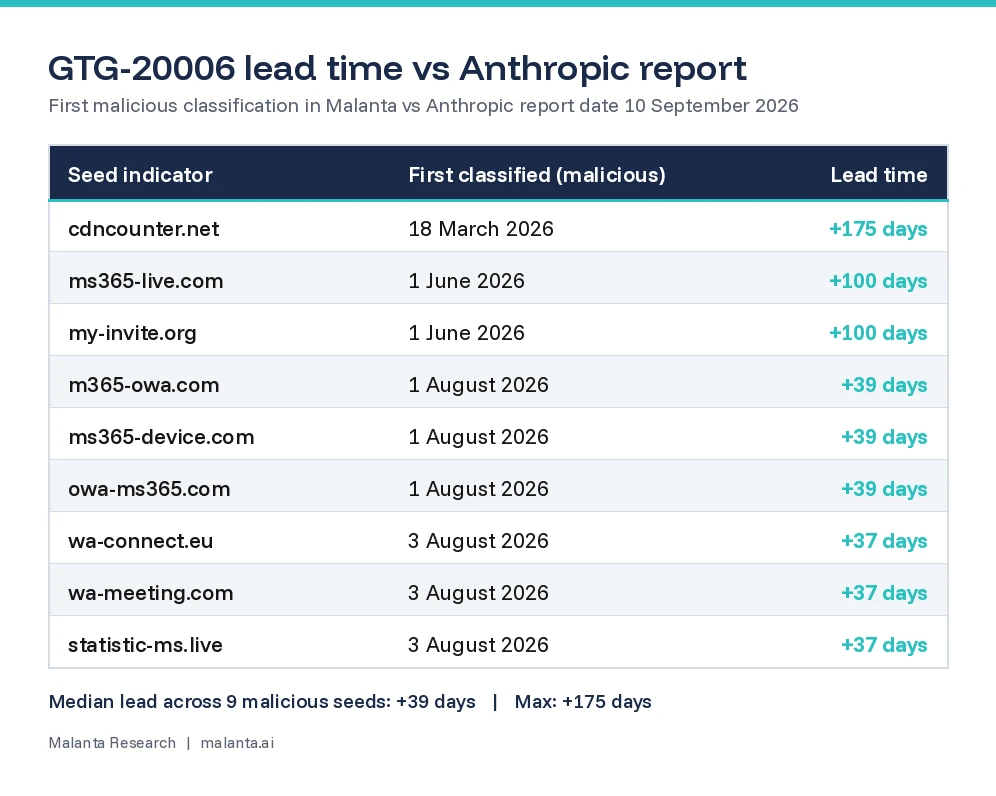
Median lead across those nine malicious seeds: +39 days. Max: +175 days.
Several of the Microsoft lookalikes also carried Russian APT attribution in Malanta's classification. Anthropic's public framing for the cluster points to Midnight Blizzard-aligned espionage. Attribution labels can differ across vendors. The operational point does not: this was staged adversary infrastructure, not random noise, and it was already in a blockable state before the report date.
Identity, not volume, is the durable signal
Three of those lookalikes - ms365-live.com, ms365-device.com, and owa-ms365.com - share a registrant identity cluster. Same ownership signal. Same campaign family. All three malicious. That is Adversary Infrastructure Identity in practice: you do not need a thousand weak pivots to understand relatedness. You need the attributes that actually bind the setup.
We also see dedicated hosting relationships that matter for hunt and block decisions - for example co-location on actor IPs used by reported seeds. Those links are useful for operators. They are not a license to inflate "expansion" counts with shared CDN noise or unrelated lookalike trees.
Honesty matters here. The Pre-Attack value in this case is not a vanity list of hundreds of high-confidence hops. It is early classification of the right infrastructure, plus a tight identity cluster that confirms continuity across Microsoft-themed staging domains.
Why this changes the CISO conversation
AI did not invent Resource Development. It compressed it.
When attackers can automate domain registration, phishing kit churn, and malware rebuild loops, static after-the-fact indicators age out faster. Mean time to detect and mean time to respond still matter. They do not cover the window when the burglar is still buying tools.
Pre-Attack Prevention is about that earlier window:
- Surface Indicators of Pre-Attack (IoPAs) and related malicious infrastructure while it is being staged
- Cluster assets by common identity attributes, not by rumor graphs
- Push validated signals into the stack you already run - TIP, SIEM, SOAR, blocking controls - so teams act before the next public report becomes the first alert
The metric that belongs in the board conversation is not only how fast you cleaned up after compromise. It is Mean Time to Preempt (MTTP): how quickly you can see and remove adversary infrastructure before it becomes a live delivery path.
GTG-20006 is a clean illustration. Public disclosure arrived in September. Parts of the staging set were already classifiable as malicious in March, June, and early August.
That is lead time you can operationalize.
How to read the next AI misuse report
Use a simple discipline when the next vendor or lab drop lands:
- Separate seed confirmation from expansion theater. Confirming that reported infrastructure was already malicious is value. Flooding analysts with weak multi-hop noise is not.
- Ask for classification timing relative to the public report, not just a reputation score on day zero.
- Prefer identity-linked families (shared registrant and related ownership signals) over anycast co-host coincidence.
- Map actions to the setup window: block, watch, or ignore - with campaign relevance intact.
Do that, and AI-accelerated espionage stops being only a story about attacker speed. It becomes a story about whether your intelligence timeline starts before the press release.
The Bottom Line
GTG-20006 shows how AI raises the tempo of Russian espionage operations. It does not erase the setup window. Malanta classified nine of the reported network seeds as malicious weeks to months before Anthropic's 10 September 2026 disclosure, with a Microsoft lookalike identity cluster holding three of those domains together.
Pre-Attack Intelligence is not a synonym for more indicators. It is earlier, validated visibility into adversary Resource Development - so you can hit the source while the infrastructure is still being built.
See how Malanta surfaces adversary infrastructure before public disclosure. Schedule a demo.
Frequently asked questions
What is GTG-20006?
GTG-20006 is a Russian espionage cluster documented in Anthropic's September 2026 threat intelligence report. Anthropic's attribution is consistent with public reporting linking the actor to Midnight Blizzard. The actor used AI-assisted workflows across infrastructure acquisition, phishing, persistence, and iterative malware rebuild loops.
What is the setup window?
The setup window is the period when adversary infrastructure is registered, staged, and configured before execution. Defenders who only watch post-compromise indicators experience this as quiet time. For the adversary, it is operational freedom under MITRE ATT&CK TA0042, Resource Development.
How long before Anthropic's report were GTG-20006 seeds visible in Malanta?
Nine of the reported seed domains were already classified malicious in Malanta before the 10 September 2026 report date. Lead times ranged from +37 days to +175 days, with a median of +39 days across those nine seeds.
Why does Adversary Infrastructure Identity matter here?
Three Microsoft lookalike seeds shared a registrant identity cluster. Shared ownership attributes confirm campaign continuity without relying on weak multi-hop expansion. That is how Pre-Attack Prevention keeps signal dense and actionable.
What is an IoPA?
An IoPA, Indicator of Pre-Attack, is a validated signal that adversary infrastructure is being prepared before use. IoPAs are designed to flow into TIP, SIEM, SOAR, and blocking controls while staging is still underway.
What is MTTP?
MTTP means Mean Time to Preempt. It measures how quickly a team can see and remove adversary infrastructure before it becomes a live delivery path. Against AI-compressed Resource Development, MTTP belongs in the board conversation alongside detection and response metrics.
Does Pre-Attack Prevention replace existing TI feeds and SOC tooling?
No. Pre-Attack Prevention extends the timeline those tools can see. TI feeds, SIEM, and SOAR remain necessary after execution. The gap covered here is the pre-execution setup window - earlier classification, identity-linked clustering, and validated IoPAs pushed into the stack already in place.