Left of Breach Is Where the Window Lives
This is a div block with a Webflow interaction that will be triggered when the heading is in the view.

Every security program claims to operate left of breach. Most of them, I’m afraid, don't even know where the line is.
"Left of breach" has become one of those phrases that gets used to describe everything from EDR to awareness training. Anything that fires before the breach event qualifies, by some definition. That's marketing inflation, and it's obscuring the thing the phrase was originally meant to point at.
Left of breach is a position on the adversary timeline. It's a window, observable, measurable, and currently underused. It's where the work of preparing an attack is visible if you know where to look. And it's the only place where a defender can intervene before the attack ever materializes.
The teams that have actually moved into this window aren't the ones with the biggest stacks. They're the ones who stopped treating "left of breach" as a posture and started treating it as a coordinate.
The work inside that window is what Pre-Attack Intelligence is built to see.
What the Line Is
The breach event is a discrete moment: the first successful action inside your environment. Initial access. The phishing clicks. The exploited vulnerability. Everything that happens after that is the right of breach - detection, containment, response, recovery. That's where most security programs live.
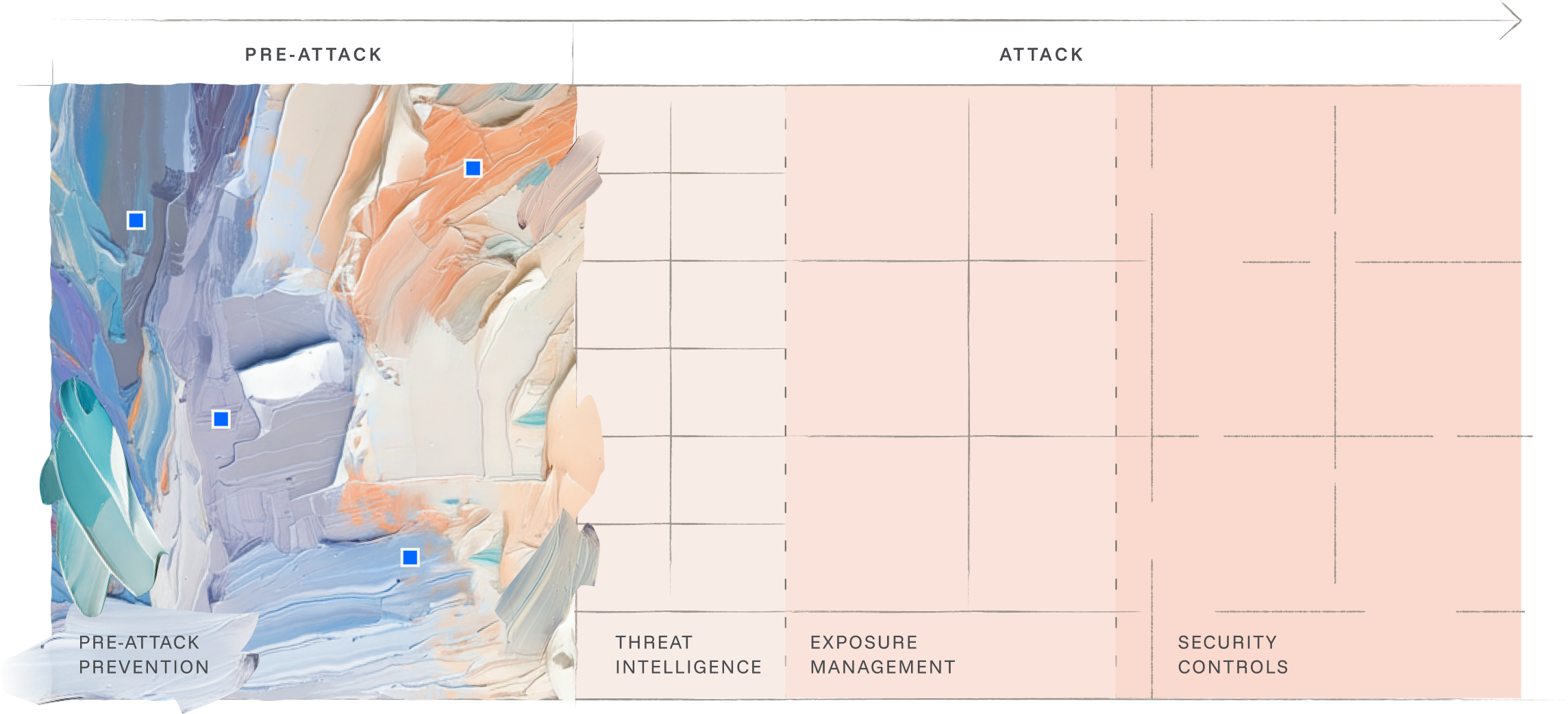
Everything that happens before is left of breach. The MITRE framework calls this the PRE-ATT&CK domain - Reconnaissance (TA0043) and Resource Development (TA0042). It's where the adversary is identifying targets, registering domains, configuring command-and-control, staging phishing kits, and building lookalike portals. Preparing the infrastructure that will eventually be used against you.
None of that activity happens inside your environment. It happens on the adversary's side of the line. And every step of it leaves a signal.
Why the Window Exists
Adversary preparation takes time. Even with AI compressing parts of the workflow, infrastructure still has to be built.
Domains have to be registered. That generates registrar records. Certificates have to be issued. That generates entries in certificate transparency logs. Hosting has to be provisioned. That creates patterns in IP allocation and DNS configuration. C2 servers have to be tested. That produces beacon traffic and connectivity patterns. Phishing kits have to be deployed. That puts code and assets on infrastructure that wasn't there yesterday.
Each of those steps leaves an artifact. Some of those artifacts are correlated with known adversary behavior. Some clusters with previous campaigns. Some line up against specific target organizations in ways that suggest intent.
That's what makes the window observable. It's not theoretical. It's a set of signals that exist before the attack launches, Indicators of Pre-Attack (IoPAs) that can be detected by anyone calibrated to look for them.
The window's duration varies. For an opportunistic phishing campaign, it might be hours. For a targeted nation-state operation, it might be weeks or months. But the window exists. And it's where left of breach actually lives.
Why Most Programs Don't Operate There
The security stack most organizations have inherited is calibrated for right-of-breach work. SIEM aggregates internal telemetry after an event. EDR fires on endpoint behavior already in progress. SOAR orchestrates response after a trigger. Threat intelligence feeds describe indicators that surface after a campaign is in motion. Metrics like MTTD and MTTR measure how fast you respond once the breach has occurred.
There's no organizational muscle for the time before. No tooling calibrated to scan adversary-side activity. No workflow that ingests signals about infrastructure being built against you. No metric measures preemption.
So the program defaults to its tooling. The tooling fires right of breach. The team operates right of breach. Left of breach gets used as marketing language because there's no operational definition behind it.
What Operating Inside the Window Requires
Moving left of breach isn't about replacing the existing stack. The right-of-breach tools still do work that needs to be done. The shift is about adding the upstream layer.
That layer has a few specific requirements.
Visibility into adversary infrastructure as it's being assembled - not after it's used. That means continuous monitoring of registrar records, certificate transparency logs, hosting telemetry, and the patterns that emerge across them.
Correlation that connects external adversary signals to your specific organization. A lookalike domain registered for a global brand is one signal. A lookalike domain registered for your brand is something else. The correlation of work is what turns generic threat data into pre-attack intelligence.
A vocabulary of actions that becomes available when you have lead time: block adversary infrastructure preemptively, submit takedowns through registrar and provider abuse channels, monitor staging behavior to feed downstream decisions, notify partners or customers when infrastructure targets them. None of those actions are available once you're working from IOCs.
A metric that measures the work. Mean Time to Preempt (MTTP) quantifies how quickly your program identifies and acts on adversary infrastructure before it activates. It's the operational counterpart to MTTD and MTTR, and it gives the work a number.
And the discipline to act on signals that don't yet match a confirmed threat. The hardest part of operating left of breach isn't the visibility — it's the judgment to intervene before the attack has happened. Right-of-breach programs are calibrated to wait for confirmation. Left-of-breach programs are calibrated to act on intent.
The Decision That Lives in the Window
This is, I believe, the part that matters most.
Every action in a security program can take collapses as the timeline progresses. When you're operating with weeks of lead time, you can submit takedowns, push preemptive blocks, monitor staging, notify partners, run all four in parallel. When you're operating with days, the actions narrow. When you're working from IOCs after initial access, blocking is the only move left, and you're racing the adversary's own clock.
Left of breach is the position where the full action set is still available. That's why the window matters. Not because earlier is philosophically better, but because earlier is where the decisions you'd rather have are still on the table.
The teams moving into the window aren't doing more security. They're doing earlier security. And they're noticing something the rest of the industry hasn't fully caught up to yet: the position you operate from determines what's possible.
Right of breach, you contain damage. Left of breach, you prevent it.
Most security programs I see are still operating on the wrong side of the line. The question isn't whether the window is real. It's whether your program is positioned to operate inside it.