Tracing the Infrastructure Behind AI-Driven Attacks

This is a div block with a Webflow interaction that will be triggered when the heading is in the view.

AI agents run intrusions in seconds. The model access, lures, and servers behind them still leave a trail.
If an AI agent can move from first target to privileged access in under three hours, what is left for defenders to see?
More than most teams assume. The FBI reports that some ARTEX-enabled intrusions reached privileged access in under three hours [1]. Google Threat Intelligence Group (GTIG) and Mandiant observed individual ARTEX execution sequences lasting roughly 2 to 25 seconds, separated by longer pauses [2]. Those bursts are not full intrusion timelines. Yet they show how fast an operator can chain actions once access and tooling are in place.
The agent is fast. The infrastructure it depends on is not. Someone still has to buy model access, stand up servers, route traffic, and, increasingly, trick defenders into downloading poisoned "AI security tools". Each of those steps leaves traces in DNS, certificates, hosting records, and code repositories. That is MITRE ATT&CK TA0042, Resource Development, and it is where this research looks.
Executive brief
What changed. Agentic offensive frameworks connect language models to offensive tooling. An operator supplies a target; agents pick tools, read results, and execute next steps. The FBI, GTIG, CrowdStrike, Microsoft, and Elastic all published on this activity between October and November 2026 [1-5]. This is operational, not theoretical.
What did not change. The techniques are familiar. What changed is the speed of chaining them and the human attention required between steps. Faster execution shrinks the response window. It does not remove the setup work that comes before it.
What we found. Malanta Research reviewed 19 offensive AI frameworks and the infrastructure around them:
- Your security team is a target. We identified more than 80 candidate GitHub repositories tied to URLhaus malware reports and branded as AI pentesting, red-team, or exploit tools [6]. The audience is researchers and security teams evaluating new tooling.
- One lure opened a wider map. A single reported "AI Security Tool" repository led, through shared download pages, commit identities, and DNS, to a 12-domain group on one server. Eleven of those domains were absent from every threat feed we checked.
- Model access is a dependency worth watching. ARTEX does not ship its own model. CrowdStrike assessed the South Korea campaign operator likely reached DeepSeek through the reseller
xcai[.]pro[3]. Model resellers belong in infrastructure investigations.
What to ask your team. Not "are attackers using AI?" They are. Ask: when a single indicator is reported, how fast do we expand it into the infrastructure around it, and how long until a control acts on what we find? That interval is Mean Time to Preempt (MTTP), and AI-compressed intrusions make it the metric that matters.
1. Where AI-driven operations still depend on infrastructure
Frameworks such as ARTEX, PentAGI, HexStrike, and Cairn sit on top of resources a defender can observe from the outside:
- Framework copies and deployments: forks, re-uploads, exposed consoles.
- Model access: API resellers, relay hosts, configuration references.
- Hosting: DNS resolutions, certificates, co-hosted domains.
- Traffic routing: proxies, tunnels, relays.
- Tool-themed malware distribution: repositories, download pages, reported malware URLs.
None of these is proof of malicious intent on its own. A fork is not an attack. A shared proxy is weak attribution. A fresh registration near a news event is context, not intent. The value appears when observations are joined with timing, content, and independently supported relationships. That join is what turns noise into Indicators of Pre-Attack (IoPAs): evidence-backed signals of preparation that support action before compromise.
There is also no universal setup window. Resources can be newly acquired, reused, shared, or compromised. Some traces appear during preparation; others only once an operation is running. The defensive job is the same either way: establish what each observation supports, connect related resources, and act while the intelligence is still useful.
2. Model access: the dependency nobody watches
ARTEX integrates with external language models. In the South Korean financial campaign, CrowdStrike assessed that the operator used DeepSeek as the primary model backend and likely reached it through xcai[.]pro, an assessed API proxy or reseller [3]. The FBI later listed the same domain as an LLM API reseller in its 13 November FLASH [1].
Malanta's historical record shows xcai[.]pro in our feed, with an ARTEX association, from 11 October 2026. That is 33 days before the FBI advisory. We want to be precise about what that means: CrowdStrike published on 7 October, describing activity from late September. Our record is coverage ahead of the advisory, not discovery ahead of the campaign.
The broader lesson matters more than the date. Model access is now part of attacker infrastructure, and it can be investigated like any other dependency.
What this means for detection. When the attacker runs the framework on their own server, its model calls never touch your network. Victim-side egress monitoring matters when a compromised workload runs an agent or calls a model itself. Unexpected model or reseller traffic from a workload with no approved AI function is a lead worth investigating, especially next to suspicious execution, credential use, or data movement. Calls to legitimate providers are not malicious by default, and blocking a shared reseller requires weighing legitimate use.
3. The lure economy: AI tools as malware bait
Demand for AI pentesting tools has created a distribution channel for malware. Repositories advertise a familiar framework or exploit, then point visitors to a separate download page or packaged binary.
We identified more than 80 candidate repositories associated with URLhaus malware-URL reports and AI-pentest, red-team, or exploit branding. Examples include Shannon-themed copies, HexStrike and AutoPentest branding, Claude-themed security kits, and a supposed "AI Security Tool" exploit.
Recurring traits included reused promotional pages, shared commit-author identities, and links to external downloads. These traits connect resources. They do not, alone, prove malware or common ownership. We did not download or execute any payload; where maliciousness rests on a URLhaus report, we say so.
Two points for leadership:
- The targets are your own people. The likely audience is security researchers and teams evaluating AI tooling, plus people seeking offensive capability. A poisoned "AI red-team kit" on an analyst laptop is a direct path into the security function.
- The theme is not the threat model. A fake AI-tool download does not mean its distributor uses AI to attack. These are two different problems that share a headline.
4. Worked example: from one lure to 12 domains
The most productive expansion started with a GitHub repository offering an "AI Security Tool" exploit for a Windows Netlogon vulnerability.
- Repository to download page. The README pointed to a GitHub Pages download site, advertising builds for several operating systems.
- Shared pages and identities. The same page and promotional material appeared across 15 repositories under seven GitHub accounts, with shared commit-author identities, Telegram references, and payment links.
- Identity to domain. One commit-author address used the domain
anubis[.]locker. Commit addresses are self-asserted and can be spoofed, so this is an association, not proof of ownership. - Domain to hosting. DNS data connected
anubis[.]lockerand a second domain matching the lure's account name to135.181.185[.]155. - Hosting expansion. The same address hosted ten more domains, including panel- and loader-themed names and one matching a repository name in the investigated account set.
Only one of the 12 domains, premiata-sng[.]com, appeared in the threat feeds we checked. The server and most of the related domains were also unclassified in Malanta at the research cutoff. That is the honest picture: this is a candidate infrastructure group surfaced by expansion, not a validated blocklist.
Not every link carries the same weight:
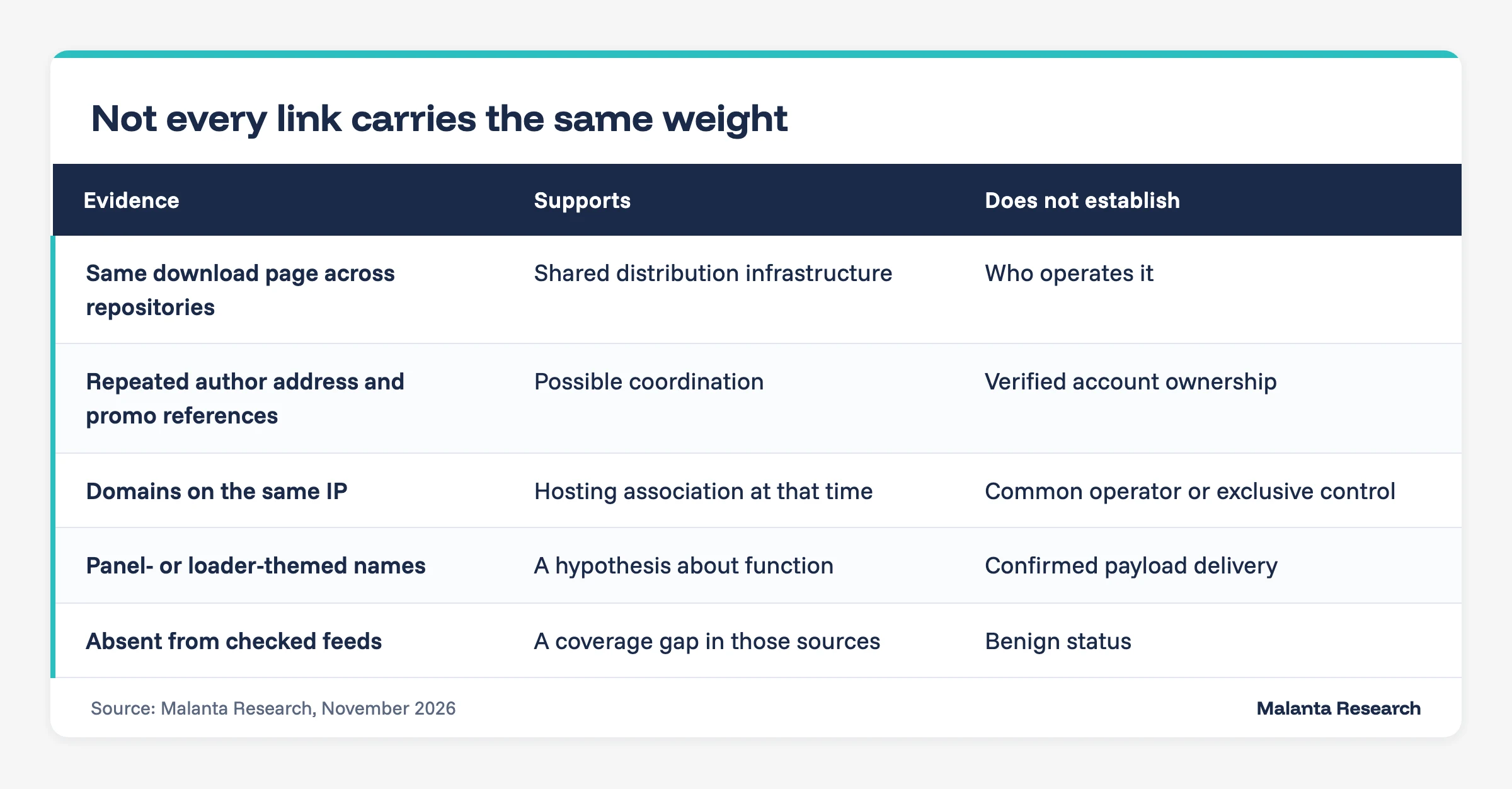
The value is the expansion itself. One public report became 12 resources a team can monitor, investigate, and decide on, most of which no checked feed was tracking.
5. What defenders can do now
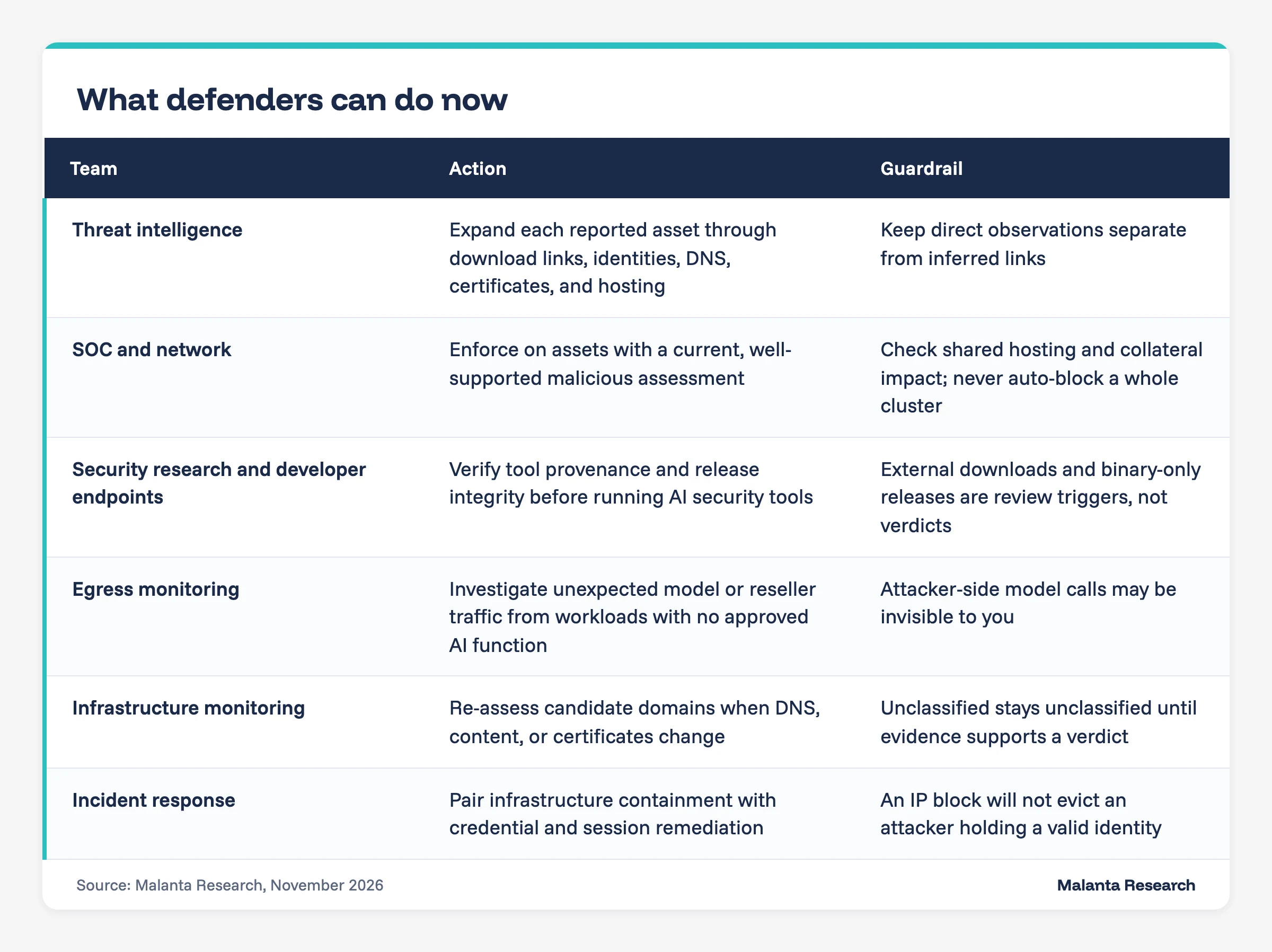
Infrastructure intelligence complements behavior-based detection and identity controls. Elastic also identifies framework infrastructure as an early blocking opportunity, while warning that consoles can sit on shared hosting or CDN addresses [5].
Where the developer path fits. The lure economy aims at the people most likely to clone and run unfamiliar repositories. The same exposure applies to AI coding agents that fetch URLs, clone repos, and run shell commands on a developer's behalf. Malanta's open-source TrustGate Cursor plugin checks the domains, IPs, and GitHub repositories an agent is about to contact against Pre-Attack Intelligence before shell, MCP, file-read, and fetch actions run, with warn, ask, or enforce modes. It puts the same destination question on the developer path: is this source part of staged infrastructure?
Five questions for any pre-attack intelligence source
- What was directly observed, and what was inferred?
- When was the evidence collected, classified, and made available?
- Does it establish general maliciousness, a targeting relationship, or only context?
- What action is justified at the current confidence level?
- What outcome can be verified after the action?
Where pre-attack timing is established, measure MTTP: the interval from first available evidence to an effective control. Record separately whether a control was applied, an interaction was blocked, or infrastructure was disrupted. None of these alone proves a breach was prevented, and honest measurement is what makes the metric credible to a board.
The Bottom Line
AI compresses the attack. It does not compress the supply chain behind it. Model resellers, poisoned tool downloads, and shared hosting all sit in TA0042, and all of them can be expanded from a single reported indicator into a wider map.
The teams that gain from this shift will not be the ones with the biggest indicator lists. They will be the ones that expand fast, keep evidence and inference separate, and act before the next advisory turns a candidate into a confirmed incident.
Bring one reported indicator. See what Malanta expands it into. Schedule a demo.
Method and limitations
This investigation used Malanta's domain, DNS, hosting, certificate, registration, reputation, and code-repository data, plus public GitHub metadata and README content. No payload was downloaded or executed, and no operator server was contacted.
xcai[.]procoverage from 11 October is a historical Malanta feed record, not independent pre-attack discovery.- Repository maliciousness rests on URLhaus provenance and repository material; no payload execution.
- Shared identities are self-asserted.
- The 12-domain group rests on DNS relationships; common control remains an analytical assessment (Confidence: Medium for shared distribution infrastructure, Low for common operator).
- "Absent from checked feeds" is scoped to the sources and snapshot used here.
- Framework-name registrations surfaced in our domain search are monitoring candidates only and are excluded from the indicators below. We also omit fork totals until deduplication and content-level validation are complete.
Findings can change as infrastructure moves and classifications update.
Research indicators (TLP:CLEAR)
Defanged. A research aid, not an import-ready enforcement feed. Validate current role and classification before acting.
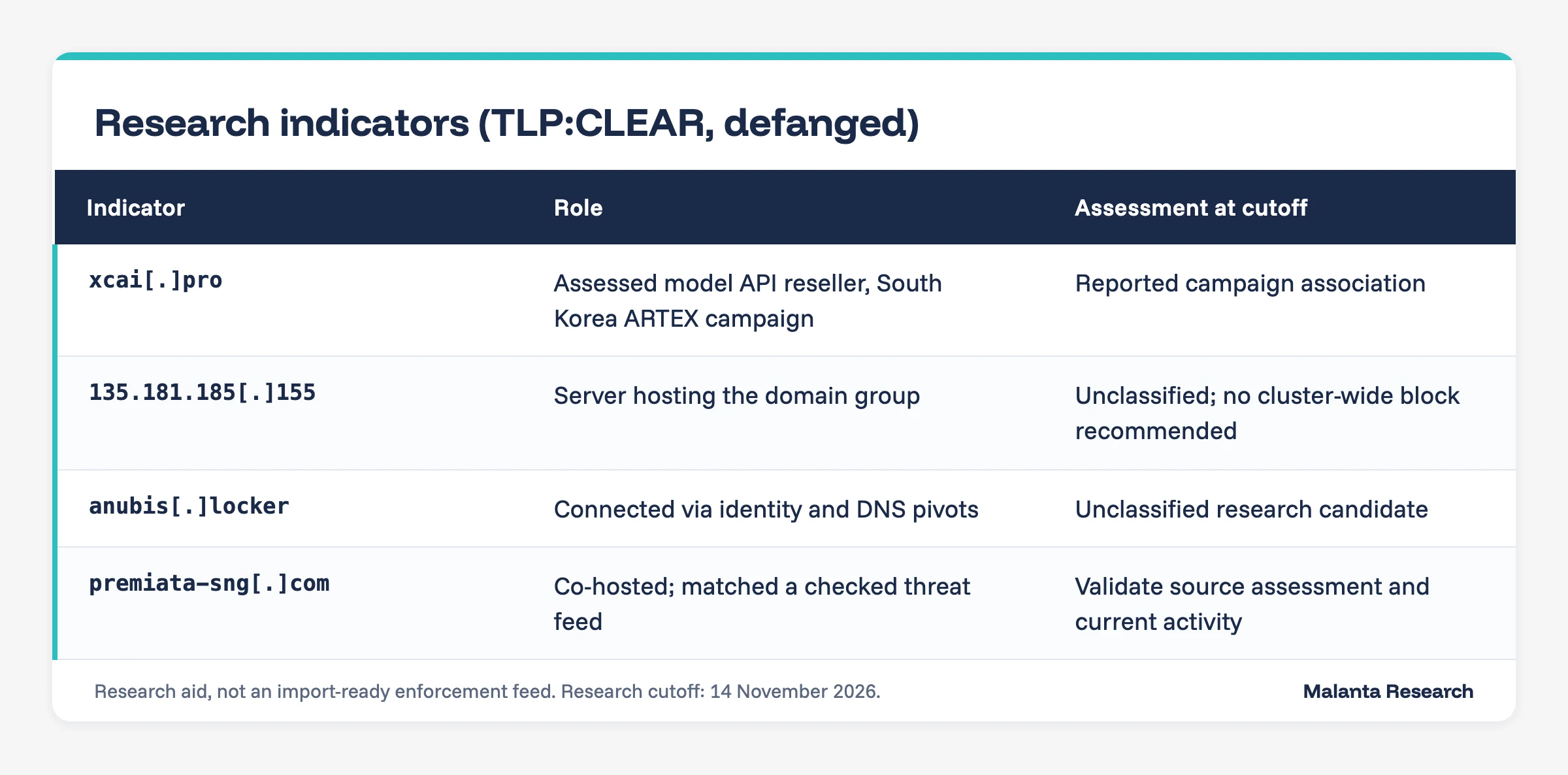
Copy-paste list (defanged): xcai[.]pro, 135.181.185[.]155, anubis[.]locker, premiata-sng[.]com
Available on demand to verified security teams from Malanta Research: the GitHub Pages download site and account set behind the lure, the second identity-linked domain, and the remaining nine co-hosted domains. These are research candidates whose individual maliciousness is not established.
References
- FBI, "Threat Overview of ARTEX Autonomous Penetration Testing Framework," FLASH-20261113-001, 13 November 2026
- GTIG and Mandiant, "ARTEX and Friends: Enter Agentic Offensive Frameworks," 30 October 2026
- CrowdStrike, "Unknown Threat Actor Uses AI-Driven ARTEX to Target South Korean Finance," 7 October 2026
- Microsoft, "AI-driven, large-scale nation-state campaign using ARTEX enables supply chain compromise," 21 October 2026
- Elastic Security Labs, "Inside the loop: Five AI attack frameworks that never ask permission," 13 November 2026
- abuse.ch URLhaus
Pre-Attack Prevention. Hit the source.
Frequently asked questions
What is an agentic offensive framework?
Software that connects a language model to offensive tools so agents can select tools, interpret results, and execute next steps toward an operator's objective. ARTEX, PentAGI, HexStrike, and Cairn are examples named in 2026 public reporting.
How fast are AI-driven intrusions?
The FBI reports some ARTEX-enabled intrusions reached privileged access in under three hours. GTIG and Mandiant observed individual execution bursts of roughly 2 to 25 seconds, separated by longer pauses.
Can defenders see AI-driven attacks before they execute?
Often, at the infrastructure layer. Model access, hosting, traffic routing, and distribution pages are acquired during Resource Development (MITRE ATT&CK TA0042) and leave traces in DNS, certificates, hosting records, and code repositories.
Are fake AI security tools spreading malware?
Yes. Malanta Research identified more than 80 candidate GitHub repositories branded as AI pentesting, red-team, or exploit tools and associated with URLhaus malware-URL reports. Security researchers and teams evaluating AI tooling are the likely audience.
What is MTTP?
Mean Time to Preempt: the interval from first available evidence of adversary infrastructure to an effective control acting on it. It measures prevention, where MTTD and MTTR measure detection and response.